


Functional Medicine is one of the most promising approaches to healthcare today. By uncovering the root causes of illness and treating the whole person—not just their symptoms—it offers patients a deeper path to recovery and long-term vitality.
But there’s a hidden truth most practitioners know all too well:
delivering that level of personalized care is complex… and that complexity can limit how many patients you can truly help.
It’s not because you lack the skill, the clinical curiosity, or the dedication. It’s because modern Functional Medicine workflows require an extraordinary amount of time and mental energy to navigate. Every patient journey involves dozens of steps, hours of documentation, and multiple handoffs between systems—all while juggling lab reports, patient histories, care plans, and follow-ups.
The result? Many practitioners find themselves spending as much (or more) time on process as they do on patients.
And when your day is dominated by paperwork, information overload, and decision fatigue, it’s nearly impossible to expand your patient load, grow your practice, or protect your own well-being.
This is exactly where FunctionalMind comes in: transforming the complexity of Functional Medicine into clarity, so you can focus on what you do best—helping patients heal.
The Unseen Barrier: Workflow Bottlenecks
The truth is, even the best-trained Functional Medicine clinician is limited by the structure—or lack thereof—of their workflow.
You could be the most skilled at uncovering mitochondrial dysfunction, mapping the gut-brain axis, or creating phase-based detox protocols. But if your intake process is messy, your care plan creation takes hours, or your follow-ups fall through the cracks, you’ll be stuck in reactive mode—constantly catching up instead of moving forward.
This isn’t just inconvenient, the cost is real: every workflow bottleneck reduces your patient capacity, slows down care delivery, and erodes the sustainability of your practice. Left unchecked, it’s a recipe for frustration, stalled growth, and ultimately, burnout.
But with the right system, those bottlenecks don’t have to define your practice. They can be replaced with clarity, speed, and the freedom to focus on what matters most—your patients.
The 3 Clinical Phases: The Backbone of an Efficient Practice
Every Root Cause Medicine case—no matter the condition, specialty, or complexity—flows through the same three clinical phases.
Think of them as the backbone of your patient care process:
- Phase 1: Intake & Assessment – Gathering and organizing the full clinical picture.
- Phase 2: Creating Comprehensive Care Plans – Converting insights into actionable, personalized protocols that patients can follow with confidence.
- Phase 3: Follow-up, Communication & Ongoing Management – Monitoring, refining, and sustaining care over time.
Master these three phases, and you gain control over your workflow.
Fail to manage them, and your days will be dictated by admin tasks, leaving less time for what matters most: transforming patient lives.
Phase 1: Intake & Assessment – Building the Clinical Foundation
If Functional Medicine is a house, Phase 1 is the blueprint. Every decision you make later depends on the quality of your intake and assessment.
But in reality, this phase can be overwhelming.
You’re expected to:
- Review years of medical history without losing sight of what matters most
- Interpret intake questionnaires that often run 10–15+ pages in length
- Unravel multiple lab panels from different providers and formats
- Spot patterns across decades of interconnected health events
- Capture every critical detail—without getting buried in data
Why this phase slows practitioners down:
- Intake data arrives fragmented (PDFs, emails, EMR exports, scanned handwritten notes)
- Key clinical events are buried in narrative text or scattered across sources
- It’s time-consuming to prepare focused follow-up questions for the first visit
- You risk missing subtle patterns if you’re rushed or distracted
Example:
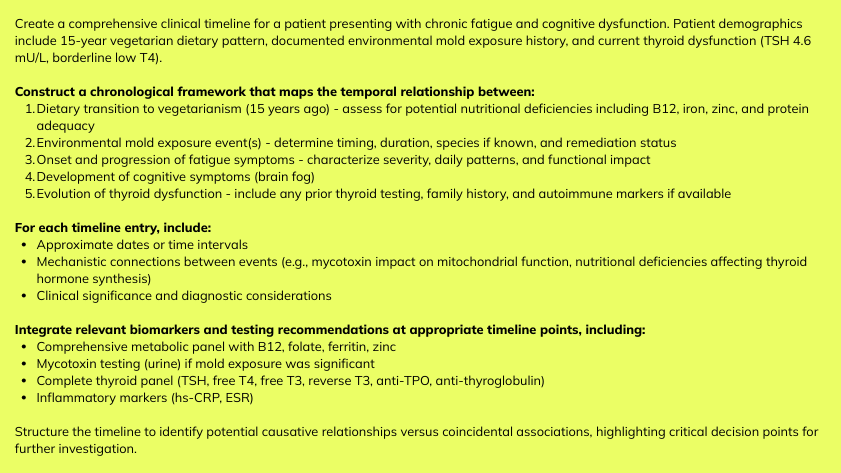
A patient presents with fatigue and brain fog. Their intake packet reveals a history of mold exposure, subtle thyroid imbalances, and a vegetarian diet for 15 years. But unless you can quickly integrate these pieces, you might not see how nutrient depletion, environmental toxicity, and thyroid function are interacting.

Tasks in Phase 1:
- Medical History Review – Diagnoses, surgeries, medications, hospitalizations, injuries, family history.
- Questionnaire Analysis – Symptom timelines, lifestyle surveys, environmental exposure forms.
- Lab Review – Standard panels, functional ranges, specialty labs, trend analysis.
- Record Reconciliation – Cross-referencing past provider notes, prescriptions, and results.
- Pattern Recognition – Identifying red flags or key themes (e.g., chronic inflammation, gut dysbiosis).
- Follow-up Question Prep – Creating a short list of clarifying questions for the first visit.
- Supplement use, current and prior.
How FunctionalMind Supports Phase 1:
- Symptom Clustering – Groups patient-reported symptoms by body system or likely pathway.
- Lab Interpretation Prep – Highlights out-of-range values, applies functional ranges, and flags trends.
- Timeline Building – Organizes events chronologically to reveal cause-effect relationships.
- Pattern Surfacing – Suggests possible connections worth exploring further.
- Question Generation – Proposes targeted clinical questions to fill gaps in the patient story.
- Transforms narrative analysis – cutting through noise, limiting bias, and creating a clearer path for fresh clinical insights.
Result: Instead of spending 60–90 minutes just organizing data, you start your first visit with a clear, structured clinical picture—ready to interpret.
Prompt (input):
“Patient intake packet includes fatigue, brain fog, vegetarian diet x15 years, history of mold exposure, thyroid TSH 4.6, T4 borderline low. Build a timeline of key clinical events.”
FM Enhanced Prompt (Output):
Phase 2: Creating Comprehensive Care Plans – Turning Insight into Action
Phase 2 is where you translate your findings into a plan that’s both scientifically sound and patient-friendly.
It’s where the real thinking work happens.
You’re not just handing out supplements or tweaking medications. You’re creating a comprehensive, root-cause strategy that may include:
- Personalized nutrition – therapeutic diets, elimination/reintroduction plans, macronutrient recalibration, or microbiome-supportive eating
- Lifestyle interventions – movement, sleep optimization, circadian rhythm alignment, stress reduction, and recovery practices
- Targeted nutraceuticals and medications – vitamins, minerals, botanicals, adaptogens, hormone therapies, or carefully chosen pharmaceuticals
- Detoxification and biotransformation support – optimizing liver pathways, gut clearance, lymphatic support, and environmental toxin reduction
- Mind-body and behavioral approaches – meditation, breathwork, mindfulness, trauma-informed care, and cognitive-behavioral tools
- Restorative practices – acupuncture, bodywork, hydrotherapy, or energy-based modalities where appropriate
- Advanced diagnostics and tracking – genomics, metabolomics, microbiome mapping, advanced lab panels, and wearable data
- Environmental and social determinants – toxin minimization, community and relational health, purpose and meaning
- Patient education and empowerment – health coaching, self-tracking tools, and guided habit-change strategies
All of this has to be sequenced, dosed, and explained—and it has to align with the patient’s readiness, capabilities and resources.
Why this phase slows practitioners down:
- Creating plans from scratch is labor-intensive
- It’s easy to overcomplicate protocols, leading to poor adherence
- Checking for interactions and contraindications requires multiple reference sources
- Patient education materials often have to be created manually
- Every care plan needs documentation for both patient and EMR

Tasks in Phase 2:
- Root Cause Hypothesis – Synthesizing intake and lab data into a working theory.
- Intervention Sequencing – Determining the order of therapeutic actions (stabilize → repair → optimize).
- Nutritional Strategy – Designing dietary protocols based on lab markers, symptoms, and preferences.
- Lifestyle Planning – Incorporating sleep, stress, movement, and environmental interventions.
- Supplement Protocol – Selecting products, doses, timing, and duration.
- Interaction Checks – Ensuring no supplement-drug or nutrient-drug conflicts.
- Patient Communication – Translating the plan into plain language with clear instructions.
- EMR Documentation – Recording rationale, goals, and review timelines.
How FunctionalMind Supports Phase 2:
- Evidence-Based Suggestions – Proposes protocol options grounded in root cause and medicine literature.
- Phased Plan Templates – Structures care into logical, manageable steps.
- Drug-Nutrient Interaction Checks – Flags conflicts instantly.
- Patient-Friendly Summaries – Rewrites complex plans into clear, motivating language.
- Supplement Protocol Builder – Formats indicated, dosing, timing, and goals automatically.
- EMR-Ready Notes – Generates a complete record with reasoning and references.
- Research Integration – Surfaces supporting studies for patient education or team discussion.
Result: A care plan that used to take over an hour can now be made in 15–20 minutes. It shows the clear steps and reasons, so you can quickly check, approve, or change it.
Prompt (input):
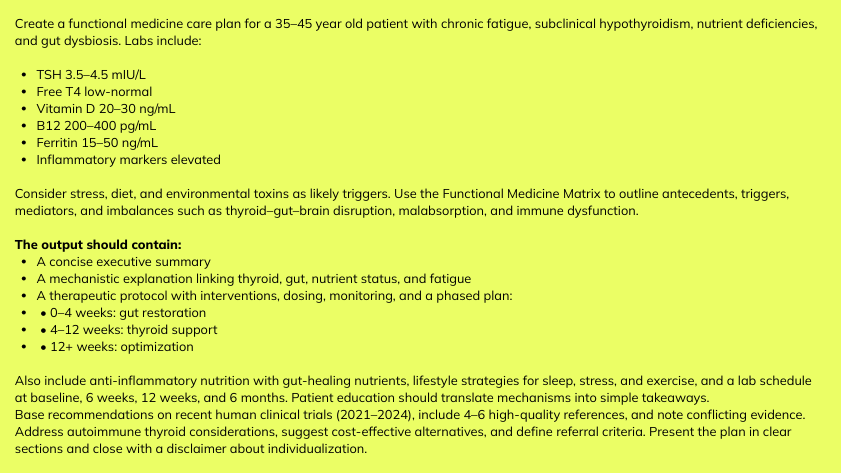
“Create a comprehensive care plan for a patient with fatigue, mild hypothyroidism, nutrient depletion, and gut dysbiosis.”
FM Enhanced Prompt (Output):
Phase 3: Follow-up, Communication & Ongoing Management – Sustaining Progress
Phase 3 is where care becomes continuous. Patients don’t just need a plan—they need monitoring, adjustments, and ongoing encouragement.
This phase involves both clinical decision-making and a large volume of communication and documentation tasks.
Why this phase slows practitioners down:
- Reviewing labs, tracking symptoms, and documenting changes can take as long as the visit itself
- Creating updated summaries, changes to protocols or referral letters eats into patient-facing time
- Keeping track of next steps and test rationales requires organized notes
- Many practitioners do follow-up unpaid admin work at night or on weekends

Tasks in Phase 3:
- Progress Review – Comparing current status to baseline intake and care plan goals.
- Protocol Adjustment – Tweaking dosages, changing supplements, adding or removing interventions.
- Lab Reordering – Deciding which tests to repeat and when, with rationale.
- Patient Communication – Preparing letters, summaries, or updated instructions.
- Referral Management – Writing concise, relevant letters for specialists.
- EMR Updating – Documenting changes and reasoning for compliance and continuity.
- Future Planning – Mapping out next steps, including maintenance-phase strategies.
How FunctionalMind Supports Phase 3:
- Progress Summaries – Consolidates labs, symptoms, and notes into a structured summary for quick review
- Automated Adjustments – Suggests care plan changes based on new data.
- Referral Letter Drafting – Pulls relevant history and findings into a professional letter format.
- Patient Summary Creation – Generates easy-to-read follow-up instructions.
- Future Testing Recommendations – Suggests next labs and explains rationale.
- Continuity Tracking – Links all past plans, tests, and notes into one view.
Result: Follow-up documentation that used to take 20–30 minutes can be completed in under 5 minutes, freeing time for patient connection.
Prompt (input):
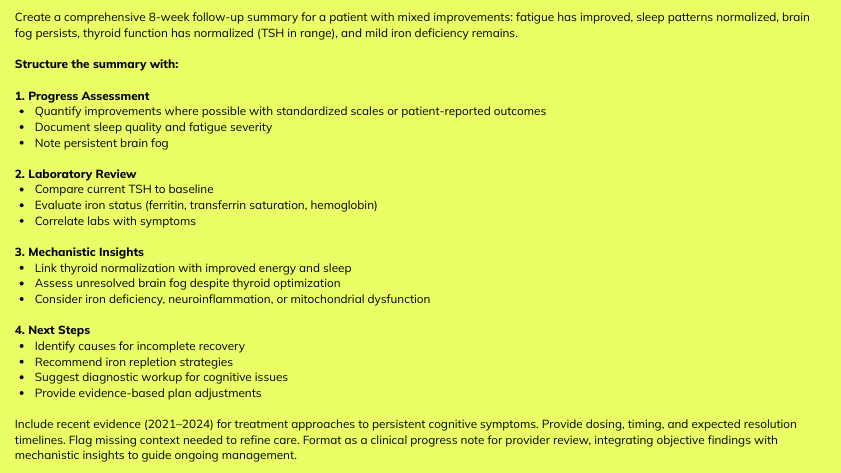
“Summarize progress after 8-week follow-up: fatigue improved, sleep normalized, brain fog persists, thyroid TSH normalized, still mild iron deficiency.”
FM Enhanced Prompt (Output):
Why FunctionalMind Is Different
General AI tools like ChatGPT weren’t built for clinical care—especially not the complexity of Functional Medicine.
FunctionalMind was purpose-built to:
- Understand root-cause, systems-based thinking
- Work with functional lab ranges and integrative protocols
- Avoid “data drift” and bias between patient cases
- Provide structured, chain of reason, audit-ready outputs
- Support compliance with healthcare privacy regulations and governance
Most importantly, FunctionalMind doesn’t replace your judgment—it amplifies it.
What’s Next in the Clinical Workflow Series
This Core Concept Overview sets the stage. In the next three articles, we’ll go deep into each phase:
- Phase 1 – Intake & Assessment
- Phase 2 – Creating Comprehensive Care Plans
- Phase 3 – Follow-up, Communication & Ongoing Management
Each will break down phase-specific tasks, time-saving AI applications, and cross-phase workflow benefits.
Read the next post in the series →
Ready to Reclaim Your Clinical Time?
Start your free trial of FunctionalMind and see how purpose-built AI can help you serve more patients, with less effort—without compromising the quality of care.
